Lawn Fertilization 30A Florida: What Your Sandy Soil Actually Needs
A yellow or thinning lawn does not always need more fertilizer. Successful lawn fertilization 30A Florida begins with understanding sandy soil, grass type, irrigation, seasonal growth, and the difference between a true nutrient deficiency and stress caused by pests, disease, shade, salt, or poor watering.
Coastal lawns around Santa Rosa Beach, Niceville, Freeport, and the greater Emerald Coast often grow in fast-draining soil with low nutrient-holding capacity. Heavy rain can move soluble nutrients below the root zone, while excessive fertilizer can create rapid top growth, disease pressure, root stress, and nutrient runoff.
The best program is not the one that applies the most product. It is the one that supplies the right nutrient, at the right rate, during active growth, with enough slow-release material to support steady color and density.
Why Lawn Fertilization 30A Florida Is Different
Florida’s coastal sands contain less organic matter and hold fewer nutrients than many inland soils. Water and dissolved nutrients move through the profile quickly, especially after heavy rain or excessive irrigation.
That does not mean every sandy lawn needs frequent fertilizer. Mature turf that recycles clippings may need less than newly installed sod on disturbed construction soil. Shade, soil pH, irrigation quality, and species also change how the lawn responds.
Lawn fertilization 30A Florida must therefore start with site conditions rather than a generic bag schedule. Two neighboring lawns may need different programs even when they contain the same grass.
Salt exposure adds another layer of stress. Windborne salt can damage leaves, and saline irrigation water can interfere with nutrient uptake. Applying more nitrogen will not solve a salt problem and may make weakened turf more vulnerable.
What Sandy Soil Does to Nutrients
Sandy soil contains large particles and wide pore spaces. It drains well, but it has limited capacity to retain positively charged nutrients and little organic matter to buffer changes.
Nitrogen in quick-release form can dissolve rapidly and move with water. Potassium is also vulnerable to loss, even though it is important for stress tolerance. Phosphorus may not be needed unless a soil test or establishment recommendation supports it.
This is why sandy soil lawn care Florida programs often use smaller, properly timed applications rather than one large feeding. Steady nutrition reduces the cycle of dark green growth followed by rapid decline.
Lawn fertilization 30A Florida should also account for recycled clippings. When mowing is correct and clippings remain on the lawn, some nitrogen and potassium return to the soil naturally.
Start With a Soil and Lawn Assessment
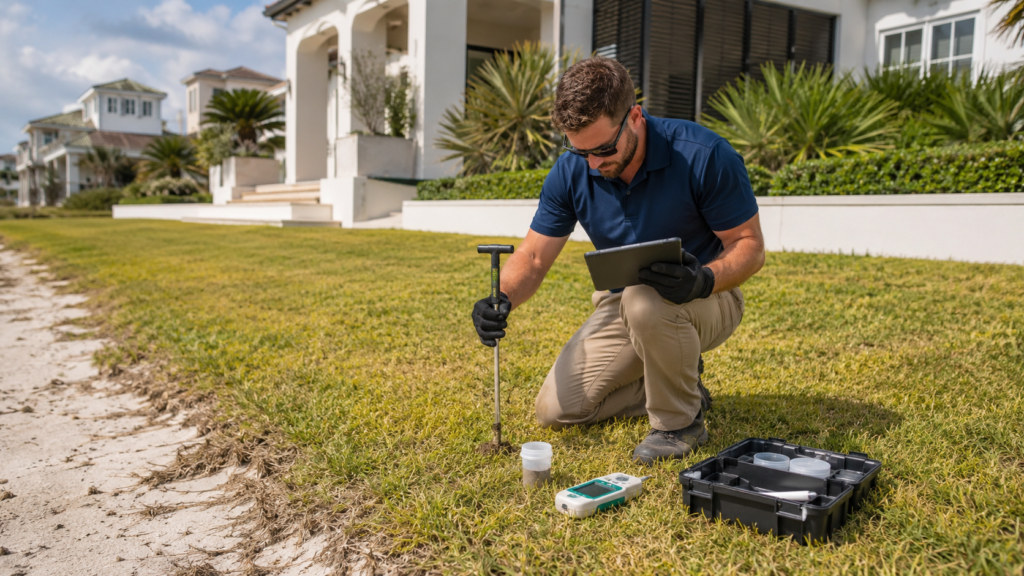
A soil test can measure pH and selected nutrients, but it does not answer every turf question. Diagnostic lawn fertilization 30A Florida combines the test with a physical inspection. The lawn should also be inspected for grass species, root depth, irrigation coverage, disease symptoms, insects, compaction, thatch, shade, and salt exposure.
The University of Florida’s guidance on when to lime soil explains that soil pH affects nutrient availability and that many Florida mineral soils are naturally acidic. Lime should be applied only when testing shows it is needed.
A struggling lawn may look nutrient deficient when the roots are damaged or water is distributed unevenly. Fertilizer cannot correct a broken irrigation head, compacted construction soil, or turf planted in deep shade.
A professional lawn fertilization 30A Florida assessment should answer three questions: what is limiting the turf, what can fertilizer realistically improve, and what must be corrected first.
Test Before Adding Lime or Phosphorus
Lime raises soil pH. It is not a general lawn vitamin, and unnecessary lime may reduce the availability of iron and manganese.
Phosphorus should also be used carefully. Established Florida lawns often need little or none unless testing, establishment conditions, or a specific recommendation supports application.
Diagnose Yellowing Correctly
Yellowing may come from nitrogen deficiency, iron chlorosis, manganese issues, drought, waterlogging, disease, insects, root damage, or mowing stress.
The pattern matters. Uniform pale color suggests a different cause than irregular patches, yellow streaks, or decline beside a driveway or irrigation head.
Slow-Release Versus Quick-Release Fertilizer
Quick-release nitrogen becomes available rapidly. Controlled lawn fertilization 30A Florida uses that fast response carefully rather than relying on it for every treatment. It can produce fast color, but it also increases the risk of excessive growth, leaf burn, and nutrient loss when poorly timed.
Slow-release fertilizer Florida products deliver nitrogen over time. Release may be controlled by coatings, microbial activity, moisture, or temperature depending on the material.
UF/IFAS guidance on fertilizing Florida lawns recommends measuring the turf area and applying no more than one pound of nitrogen per 1,000 square feet in a single application.
Lawn fertilization 30A Florida generally benefits from a meaningful slow-release component because sandy soil and heavy summer rainfall can make soluble nitrogen difficult to manage. The exact product and rate should still follow the label and local requirements.
When Quick Release May Be Used
A limited soluble component can support an appropriate response when turf is actively growing and conditions are suitable. It should not be used as a shortcut to force color into dormant, diseased, drought-stressed, or newly damaged turf.
Liquid applications can also deliver micronutrients or small amounts of nutrition evenly, but they require accurate calibration.
Why More Is Not Better
Excess nitrogen may create soft, fast-growing leaves while roots remain weak. It can increase mowing demand and make some turf diseases more severe.
Overfeeding also masks underlying problems temporarily. The lawn turns green for a short period, then declines again because irrigation, roots, pests, or soil conditions were never corrected.
The Nutrients Florida Turf Actually Uses
Nitrogen drives leaf growth and color. Potassium supports water regulation, stress response, and general turf resilience. Phosphorus supports energy transfer and root development but is not automatically needed in established lawns.
A complete lawn nutrition Emerald Coast program may also consider magnesium, sulfur, iron, manganese, and other micronutrients when symptoms and site conditions support them.
The fertilizer analysis on the label lists nitrogen, phosphate, and potash in that order. A product labeled 16-0-8 contains 16 percent nitrogen, no phosphate, and 8 percent potash by weight.
Lawn fertilization 30A Florida should focus on pounds of nutrient applied per measured lawn area, not simply the number of bags or the product analysis.
Iron, Manganese, and Coastal Lawn Color
Iron can improve color without creating the same leaf-growth response as nitrogen. Targeted lawn fertilization 30A Florida may use iron when the diagnosis supports it. It is especially useful when turf is actively growing but appears pale due to limited iron availability.
High pH can make iron and manganese less available even when those elements are present in the soil. This is why indiscriminate liming can create or worsen chlorosis.
Iron applications may stain concrete, pavers, walls, and pool surfaces. Products must be applied carefully, and granules or spray should be kept off hardscape.
Lawn fertilization 30A Florida should not use iron as a substitute for diagnosing root problems. A temporary color response does not prove the lawn is healthy.
Fertilization Timing for Northwest Florida
Warm-season grasses should be fertilized when they are actively growing, not simply because the calendar says spring has arrived. Seasonal lawn fertilization 30A Florida follows turf activity and weather. Northwest Florida may experience late cold events that delay reliable growth.
Wait for consistent green-up and active mowing before making the first significant nitrogen application. Feeding too early can support tender growth that is vulnerable to cold and disease.
Summer programs must consider rainfall and local fertilizer restrictions. Do not apply before a heavy storm or when the soil is saturated.
Fall lawn fertilization 30A Florida should avoid pushing excessive late growth. The final timing and nutrient choice should reflect grass species, lawn condition, weather, and current local rules.
Spring
Inspect the lawn first. Correct irrigation problems, identify weeds, confirm the grass type, and wait for active growth.
A measured, slow-release-focused application may support recovery when the turf is healthy enough to respond.
Summer
Summer is the highest-growth period, but it is also when rainfall, heat, pests, and fungal disease create stress. Fertilizer should be coordinated with mowing and irrigation rather than applied automatically.
Avoid high rates during extended rainy periods. If the lawn is declining, diagnose the cause before adding nitrogen.
Fall
Fall nutrition should support stable turf without creating a flush of tender growth. Potassium needs may be considered based on the program and lawn condition.
Do not assume a winterizer label makes a product appropriate for every coastal lawn.
Grass Type Changes the Fertilizer Program
St. Augustinegrass, zoysiagrass, centipedegrass, and bermudagrass have different growth habits and maintenance expectations.
St. Augustinegrass can respond strongly to nitrogen but may develop disease or insect problems when overfed. UF/IFAS notes that newly sodded St. Augustinegrass on sandy soil with little organic matter may require more fertilizer than an older, established lawn.
The best fertilizer St. Augustine grass Florida program is therefore not one fixed schedule. It should reflect cultivar, shade, clipping return, soil, and management level.
Centipedegrass generally prefers lower fertility and can decline under aggressive nitrogen programs. Bermudagrass may tolerate and require more frequent feeding in high-maintenance, full-sun sites. Zoysiagrass can form dense turf but may accumulate thatch when growth is pushed too hard.
Lawn fertilization 30A Florida must match the grass rather than treating all green turf alike.
Irrigation and Fertilizer Must Work Together
Fertilizer should be watered according to the product label, but excessive irrigation after application can move nutrients below the roots or into runoff.
Before fertilizing, check the irrigation system for broken heads, poor pressure, blocked nozzles, overspray, and uneven coverage. Efficient lawn fertilization 30A Florida depends on even water distribution. Dry spots should not receive extra fertilizer to compensate for missing water.
Deep, infrequent irrigation is generally more useful than daily shallow watering for established turf. The actual schedule should respond to rainfall, soil moisture, and signs of wilt.
Lawn fertilization 30A Florida becomes more efficient when irrigation is calibrated. Internally link this section to the irrigation article and any relevant repair service page.
Over-Fertilization Hurts Turf and Water Quality
Excess fertilizer can burn leaves, increase thatch, create shallow growth, worsen disease pressure, and raise mowing demand. Responsible lawn fertilization 30A Florida avoids forcing growth the roots cannot support.
Nutrients that move off the lawn can enter streets, storm drains, ponds, bays, and coastal waters. Granules should be swept or blown back onto the turf instead of washed into drainage systems.
Do not fertilize before heavy rain. Maintain required setbacks from water and follow current product labels and local ordinances.
Responsible lawn fertilization 30A Florida protects both the property and the surrounding Emerald Coast environment.
Common Fertilization Mistakes
The first mistake is treating every yellow lawn with nitrogen. Yellowing may come from iron availability, root injury, insects, disease, water stress, shade, or salt.
The second is applying fertilizer without measuring the lawn. Guessing by bag count can easily exceed the intended nitrogen rate.
The third is using high-phosphorus products without a demonstrated need. The middle number is not automatically beneficial to established turf.
The fourth is feeding dormant or severely stressed grass. Turf must be capable of using the nutrients.
The fifth is ignoring weather. A technically correct product applied before a major storm may still perform poorly.
The sixth is using lawn fertilization 30A Florida as a replacement for proper mowing, irrigation, weed control, and pest management.
A Practical Lawn Fertilization 30A Florida Program
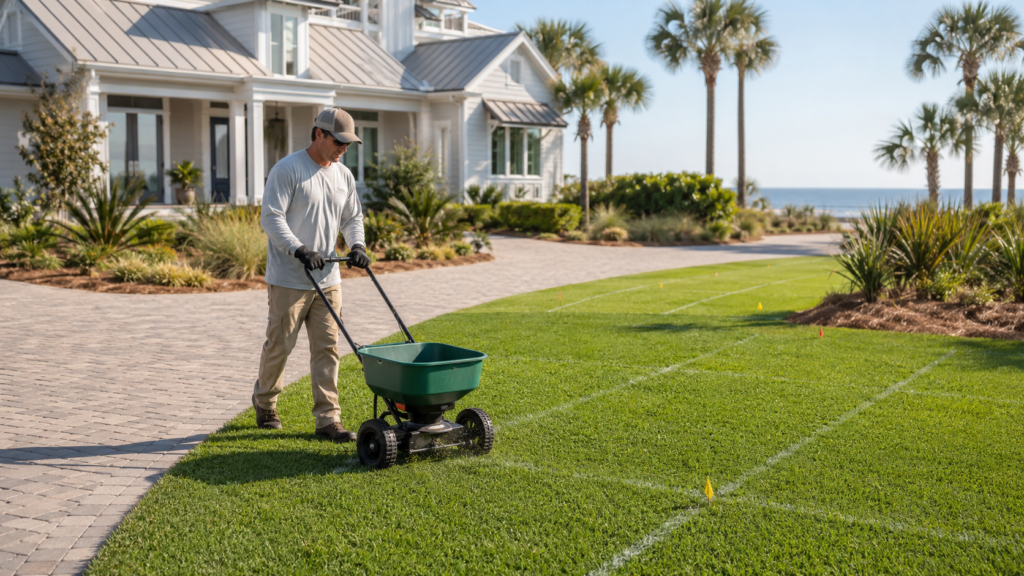
A good program begins with assessment and measurement. Measured lawn fertilization 30A Florida is more reliable than applying a standard bag to every property. Determine the grass type, actual turf square footage, soil pH, irrigation condition, and visible stress patterns.
Next, choose a fertilizer that matches the lawn and label requirements. Calculate the amount needed to deliver the intended nitrogen rate.
Apply evenly with calibrated equipment. Keep material off pavement and water bodies, and follow label instructions for irrigation after treatment.
Record the date, product, analysis, rate, weather, and observations. This history helps prevent duplicate applications and reveals how the lawn responds over time.
Lawn fertilization 30A Florida should be adjusted after every major change,including new sod, irrigation repairs, tree removal, storm damage, or a change in property use.
When Soil Amendments Help
Organic matter may improve water and nutrient retention in sandy soil, but it should be used carefully. Thick topdressing can smother turf or create an incompatible layer.
A thin, suitable topdressing may be helpful during active growth when applied correctly. Core aeration may improve infiltration in compacted areas, but severe construction compaction may require more extensive correction.
Soil amendment coastal Florida decisions should be based on the actual profile. Adding material without understanding drainage and grade can create new problems.
Lawn fertilization 30A Florida works best when the root zone is healthy enough to use the nutrients being supplied.
Vacation Rentals and Managed Properties
Rental and managed properties need consistent appearance, but they also experience heavy traffic, irregular occupancy, and pressure for fast cosmetic improvement.
The maintenance company should coordinate fertilization with mowing, irrigation, guest schedules, and property access. Product should not be left on walkways, patios, pool decks, or pet areas.
Remote owners need clear reports. Each treatment record should include the product, rate, date, observations, and any recommended repairs.
A professional lawn treatment Santa Rosa Beach program can prevent multiple vendors from applying overlapping products without shared records.
Lawn fertilization 30A Florida should create predictable results without unnecessary growth that increases mowing and cleanup during peak rental season.
When to Call a Professional
Professional help is useful when a lawn repeatedly turns yellow, fertilizer results are inconsistent, irrigation coverage is uncertain, or turf decline continues despite treatment. Professional lawn fertilization 30A Florida should begin with diagnosis rather than product selection.
A qualified provider should inspect the lawn before recommending a program. The assessment should consider species, soil, water, roots, pests, disease, weeds, and maintenance history.
The goal is not to sell the strongest fertilizer. It is to identify the limiting factor and create a measured program.
Internally link this section to the fertilization service, the lawn maintenance service, the year-round lawn care guide, the coastal landscaping guide, and the irrigation article.
Give the Lawn What It Can Actually Use
Healthy color comes from a functioning root system, correct mowing, reliable irrigation, active growth, and balanced nutrition.
Lawn fertilization 30A Florida should never be a guess based on color alone. Sandy soil requires accurate rates, appropriate timing, and enough slow-release nutrition to reduce waste and sudden growth.
When soil pH, micronutrients, water, and grass type are evaluated together, the lawn can respond more consistently with fewer unnecessary treatments.
Book a soil and lawn assessment with Salty Air Landscaping to find out what your coastal lawn actually needs.
Related posts

Landscaping Near Me 30A: How to Find and Vet a Local Company

Outdoor Property Maintenance 30A: Complete Exterior Care Beyond the Lawn
Storm Prep Landscaping 30A: A Homeowner’s Seasonal Checklist

Builder Landscape Packages 30A: What New Construction Homes Need From Day One