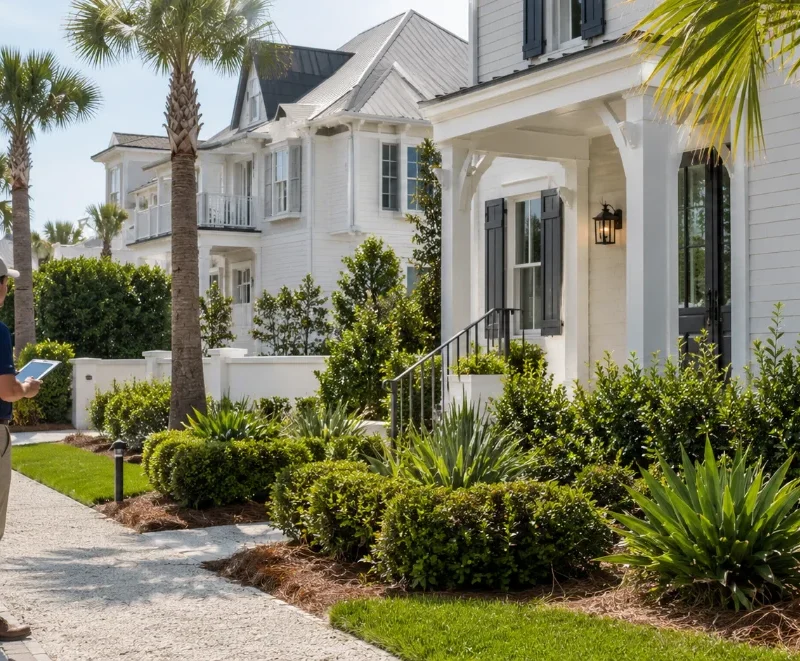
There’s a reason 30A real estate listings lead with outdoor spaces. When you own a home along Scenic Highway 30A — whether it’s a permanent residence in Seagrove Beach, a luxury second home in Alys Beach, or a builder-spec home in WaterColor — your outdoor living area is as valuable as any room inside. Often more so.
The problem is that not all outdoor spaces are created equal. A beautiful paver patio installed with the wrong materials for coastal conditions will spall, shift, and discolor within a few years. At Salty Air Landscaping & Maintenance, we’ve designed and installed hardscapes across the 30A corridor for over a decade. This guide covers what you need to know before investing in an outdoor living space on the Gulf Coast.
What Makes Coastal Hardscaping Different
Salt air corrosion
Coastal air carries salt particles that accelerate corrosion of metal fasteners, railings, and fixtures. It also affects certain stone and concrete products over time. Material selection matters enormously — what works in Atlanta or Nashville fails here.
Sandy, unstable substrate
Most of 30A sits on fine quartz sand. Without proper base preparation — compacted aggregate base material, sand leveling course, and proper drainage planning — pavers shift, settle unevenly, and heave. We regularly see budget installations that look beautiful for one season and need complete re-installation by year three.
High water table and heavy summer rain
Walton County receives significant rainfall, and many 30A lots have limited natural drainage. Hardscape design must account for water movement — where does it go when three inches of rain falls in an afternoon? Poorly designed outdoor spaces become pools; well-designed ones stay dry and functional.
Paver Patios: The Foundation of Every Outdoor Living Space
Concrete Pavers
High-quality concrete pavers are dense, resist moisture absorption, and hold up well in salt air environments. They’re available in dozens of colors, textures, and sizes — from tumbled finishes that look like aged stone to clean modern formats. They’re also more cost-effective than natural stone while delivering excellent durability. Look for pavers with water absorption rates below 5%, which indicates sufficient density for coastal applications.
Travertine
Travertine has become increasingly popular on 30A’s luxury properties. It’s a natural stone that stays cooler underfoot than concrete (important for pool decks and barefoot living), has a timeless aesthetic that photographs beautifully, and is naturally slip-resistant when properly finished. Properly cared-for travertine lasts for decades.
Brick Pavers
Classic and durable, with a warm traditional look that suits many of 30A’s cottage-style and Floribbean architectural styles. Some brick paver driveways and paths along 30A have been in service for 30+ years with minimal maintenance.
Installation: Where Most Projects Succeed or Fail
The most common paver installation mistake on 30A isn’t choosing the wrong paver — it’s inadequate base preparation. Proper coastal paver installation requires a minimum of 6 inches of compacted crusher run aggregate base, a 1-inch bedding sand course for leveling, and proper aluminum or steel edge restraints secured into the base. On 30A, we also assess drainage patterns for every project before installation.
Pool Deck Design and Installation for 30A Homes
Travertine for Pool Decks
Travertine is the gold standard for pool decks on premium 30A properties. Its natural coolness underfoot is a significant comfort advantage in Florida summers, its slip resistance is superior to most concrete products, and it’s chlorine and salt-resistant.
Brushed or Tumbled Concrete Pavers
An excellent mid-range option. The textured surface provides grip, and the joint sand between pavers handles the expansion and contraction that pool environments create. Avoid smooth-finished pavers near pool water — they become dangerously slick.
What to Avoid on Pool Decks
Standard broom-finished concrete is the cheapest option and ages the worst. It stains, cracks, and by year five typically looks 20 years old. If you’re resurfacing an existing concrete pool deck, consider pavers or travertine as the overlay — they solve the cracking problem while dramatically improving aesthetics.
Fire Pit and Outdoor Kitchen Areas
Gas vs. Wood-Burning Fire Features on 30A
Gas fire pits and fireplaces are the dominant choice on 30A for practical reasons: no ash management, no smoke, instant on/off, and they integrate with smart home automation. They also have fewer restrictions in planned communities like Alys Beach and Rosemary Beach, where wood-burning fires may be limited.
Outdoor Kitchen Considerations for Salt Air Environments
Outdoor kitchens are a significant investment — typically ranging from $15,000 to $50,000+ depending on scale and appliances. Marine-grade stainless (316 grade) is essential near the Gulf. Standard 304 stainless will rust in coastal air exposure. Aluminum and stainless cabinet framing outlasts wood and PVC in coastal environments. For countertops, porcelain tile, granite, and concrete all perform well outdoors.
Paver Driveways on 30A: Curb Appeal That Lasts
A beautifully designed paver driveway makes an immediate statement about a property’s quality — before you even see the front door. Paver driveways offer practical advantages over poured concrete or asphalt: individual pavers can be removed and reset if settling occurs, unlike poured concrete where a crack requires cutting and patching. They also handle thermal expansion better and are permeable — water drains through the joints rather than sheeting off.
Common patterns for 30A driveways include herringbone (highly interlocked, handles vehicle weight well), basketweave (traditional, used frequently in Rosemary Beach-style homes), and running bond (clean, modern look popular in contemporary Alys Beach-influenced designs). For driveways, we recommend a thicker paver (at least 2.375 inches) and a heavier aggregate base course (8 inches minimum).
Planning Your 30A Hardscape Project: Timeline and Process
We assess your site, discuss your goals, review any HOA requirements, and develop a design. For 30A properties in planned communities, we’re familiar with the architectural review processes at communities like Alys Beach, Rosemary Beach, WaterColor, and Watersound. Some premium pavers and travertine products have lead times of 2–6 weeks. On 30A, the spring season (January–April) gets extremely busy, so projects starting in Q4 get first access to spring installation windows.
A well-prepared crew installs most residential patio projects in two to five days depending on size and complexity. We review every installation with the client before calling it complete.
The Salty Air Approach to Hardscape Design
We don’t believe in one-size-fits-all hardscape packages. Every 30A property has a different architecture, different HOA requirements, different usage patterns, and different views worth framing. Our hardscape designs are built around your specific property and your specific goals. We work with homeowners, custom builders, production builders, HOAs, and property managers — bringing the same level of craft to a small patio addition as we do to a full outdoor living area build.
Ready to design your outdoor living space? Call (850) 520-1617 or request a free estimate at saltyairco.com.
Salty Air Landscaping & Maintenance provides paver installation, patio construction, outdoor living area design, and hardscaping throughout 30A — including Rosemary Beach, Alys Beach, WaterColor, Seaside, Seagrove Beach, Watersound, Grayton Beach, Blue Mountain Beach, Santa Rosa Beach, Inlet Beach, and surrounding Walton County communities.
Related posts

Landscaping Near Me 30A: How to Find and Vet a Local Company

Outdoor Property Maintenance 30A: Complete Exterior Care Beyond the Lawn
Storm Prep Landscaping 30A: A Homeowner’s Seasonal Checklist
Builder Landscape Packages 30A: What New Construction Homes Need From Day One
Lawn Fertilization 30A Florida: What Your Sandy Soil Actually Needs